Not only is it politically sensitive now, in the current political climate, where we are being asked to believe that a wave of “stochastic” Left-Wing terrorists are poised to bring down our Democracy on behalf of Russia or China … like Luigi, Robinson and the kid who blew Trump’s ear clean off on the Ayatollah’s orders or whatever. But it’s also difficult to explain why it is so so so important to understand this time period and what really went down to an audience.
Basically, what happened then created the reality that we inhabit now. The way we use “Left” and “Right” in politics, the birth of the Prussian-style Totalitarian state and its ever-present intelligence agencies, the explosion out of the ghettos and the takeover of society by the Ch*sen mafia, and a rolling wave of revolutions, assassinations, strikes, wars and false flags all defined this period. More and more, I find that the foundations of the modern new world order were all laid down in the late 19th, not the aftermath of WWII.
For example, George W. Bush’s “War of Terror” was not the the first of its kind.
This is a much older term and political psyop from the 19th century. The 19th century saw the renaissance of organized political terrorism, and it was employed en masse by various groups, but most notably the governments of the major powers themselves to justify brutal crackdowns on the population. Here’s a list of prominent assassinations or near-misses from that time period into the early 20th:
Tsar Alexander II of Russia U.S. President James A. Garfield French President Sadi Carnot Spanish Prime Minister Antonio Cánovas del Castillo Empress Elisabeth of Austria King Umberto I of Italy U.S. President William McKinley King Carlos I of Portugal Crown Prince Luís Filipe of Portugal Russian Prime Minister Pyotr Stolypin Spanish Prime Minister José Canalejas King George I of Greece Kaiser Wilhelm I of Germany King Alfonso XII of Spain Henry Clay Frick Prince of Wales King Leopold II of Belgium King Alfonso XIII of Spain Queen Victoria Eugenie of Spain Judge Benoît Prosecutor Bulot Liceu Theatre French Chamber of Deputies Café Terminus Wall Street / J.P. Morgan bank
All of this activity vanished without a trace in the 1930s onwards and was then forgotten.
Now, Bakunin was treated like the Osama bin Laden of his time and his very existence cited as a reason to shut down and arrest all “Socialists”.
The Communists, mercifully, were spared such treatment for some reason …
And the comparison is even more apt than it appears at first glance. Like bin Laden, Bakunin was NOT to blame for the major terrorist attacks of the 19th century. Most of them went after targets that did not further his aims, were committed while he was incarcerated, or after his death. Still, the mockingbird media types of his time and for the next half century were eager to dub him the “Satan of Europe” for his rejection of the Judeo-Christian Morality-On-Which-Our-Western-Civilization-Rests Values.
In God and the State, Bakunin writes:
"But here steps in Satan, the eternal rebel, the first freethinker and the emancipator of worlds. He makes man ashamed of his bestial ignorance and obedience; he emancipates him, stamps upon his brow the seal of liberty and humanity, in urging him to disobey and eat of the fruit of knowledge."
And the title that he is the most remember for is “the Father of Terrorism”.
While that’s a very enviable grimdark WH40K nickname to have attached to your legacy, I feel obligated to point out that Bakunin was most certainly NOT the father of terrorism. Sparta was the origin of terrorism, with its mythical founder Lycurgus most fit to bear the title or honor of “Father of Terrorism”. The Spartan Elite ruled through systematic use of terror against a vast helot population. Sparta also invented the secret police, the Krypteia which was used to monitor the population for WrongThink, and contraband that might have been smuggled in from the outside world into their hermit kingdom and to commit constant and systematic terror killings to keep the population in line.
Furthermore, the most famous terrorists in living memory of Bakunin’s time, were the Jacobins of France, who literally took inspiration from Sparta and used terror on both the previous monarchy and their co-revolutionary former allies to gain and maintain power. Thankfully, the Thermidorans rallied and killed off the Jacobin leadership and their secret police.
On the Spartan Terror of the Jacobin Government
Yes, the Thermidorians were the political coalition that overthrew Robespierre on the date of the 9th of Thermidor (July 27, 1794). In the months that followed, they launched a sustained ideological campaign against the fallen Jacobins. They accused the Jacobins of trying to force France into a brutal, anachronistic "Spartan" mold, the Jacobins were branded as "Spartiates de la Convention" (Spartans of the Convention), usurpers who had tried to impose a draconian, austere model on modern France, sacrificing individual liberty to a collective, militarized "happiness" and turning the French people into a mass of helots ruled by a small, Platonic elite.
“( … ) the most authentic members of the Terror system, who only came into conflict with Robespierre for reasons related to their personal ambition,” writes Sybel.
Immediately afterward, it is asserted that the Jacobins, these “Spartans of the Convention,” wanted to use their terror-mongering domination to impose an ancient situation on the present day, sacrificing individual liberty to so-called collective liberty, and millions of French people to a Spartan-style public happiness.
The statements by which the Jacobins distanced themselves from the Spartan model are passed over in silence. Little concern is shown for the coherence of the propaganda; thus, at the same time, the rumor is spread that Robespierre, precisely, amassed wealth in secret and led a life of luxury with mistresses.
Another comparison was certainly more relevant: that which the famous economist Dupont de Nemours, a former moderate deputy who escaped the guillotine only thanks to the fall of Robespierre, drew between the Reign of Terror and the government of the “Thirty” in Athens. He takes up a speech by Lysias on the period of terror in that city and applies it to the Committees of Public Safety and General Security, replacing the names of the Athenians whom Lysias cites as terrifying men with those of the members of these committees.
Of Saint-Just – born in 1767, executed at the same time as Robespierre on July 28, 1794 – it will be said in the official representation given after his fall: “A scatterbrain of twenty-six years […], barely escaped from the dust of the school, puffed up with his little erudition, had read in a great man [Montesquieu? Mably?] whom he did not understand, that a people had allowed themselves to be corrupted by luxury, child of the arts and commerce; he had also read that another great man [Lycurgus] whom he understood even less no doubt, had, within the confines of a few thousand stades, formed a people of brave men; and, immediately, our clumsy copyist of Antiquity, without examination of the localities, the customs and the population, applied […] what was inapplicable.“
We had certainly claimed to have transformed the French into Spartans, but in reality we had made them a mass of helots dominated by the force of a small majority,” said Abbé Grégoire, a few weeks after the fall of Robespierre, regarding the national education projects conceived by Lepeletier and Robespierre.
I am also always accused of misinterpreting Plato and ascribing political motivations to him that were not there.
But it is not I whomst standest accusedeth, really.
It is literally the dozens of LARPers throughout our known history that somehow read Plato, learned about Sparta, and decided to re-enact it during their own times. THEY saw something political and actionable in Plato, not me. All I’m doing is explaining what reasons and rationale motivated a good chunk of the worst villains in our political history, by quoting these people and pointing out the OBVIOUS inspiration that they took from Sparta and Plato.
I’ve written a lot about Plato and all the innovative tricks and social engineering suggestions that he provides for future Elites in his works. Having written so much on the topic, now is a good time to summarize the findings and make them as clear and discernible for everyone interested in understanding how our society is engineered.
Robespierre openly stated that his inspiration was Sparta, which he believed was superior to Athens. This is well-known among historians, but not to narrow-minded and overspecialized Philosophy majors, apparently:
Ancient Greece is one of the richest sources of Western political thought. The reflections of its philosophers and the institutions of its cities have served as models and supported intellectual constructions from the end of the Ancient World until the twentieth century, when, it is true, the classical references have slightly faded. Two separate systems distinguish themselves from the others, and have sustained attention not only by their historical importance, but by the persistent practice of later authors of contrasting their laws and their respective social rules: Athens and Sparta. One knows rather well the connection between the Ancient Greek city and the idea of democracy.
But the heritage of Sparta is more difficult to define, notably in France. Yet until the end of the eighteenth century, in the realm of political ideas, Sparta was ahead of Athens, and nearly the equal of Rome. Maximilien Robespierre is at the end of the line of reflections about the city of Lycurgus; he offered a synthesis about it, and promoted the Spartan ideal in Revolutionary France. Indeed, he could find examples and answers for his own aspirations in the history of this city. The submission to the law, the devotion to the patrie, or the regeneration of the citizen through education, are so many traits that made up the reputation of Sparta. The revolutionary context was especially propitious to the revival of these values. Robespierre, then, gave meaning to the use of Sparta in France from the Reformation to the Revolution. He illustrated its role in the construction of republican ideas.
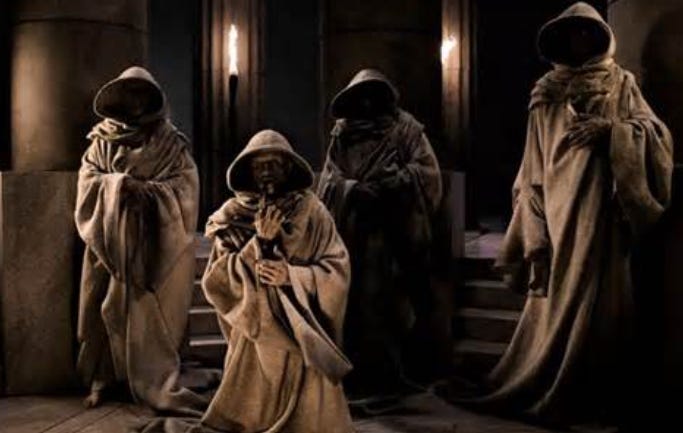
Specifically, Spartanism was seen as a challenge to Monarchism, because of its “historical” use of Ephors to curtail the power of the Spartan kings. The film 300 depicts them as deformed humanoid monsters, which I thought was a nice touch:
As an aside, this makes the case for the Torah of Moses being based on the Spartan Great Rhetra of Lycurgus even stronger, because of the intense anti-king message also found in the Bible. If you were lucky enough to have avoided Christian schooling, then allow me to inform you that in the central narrative of the Old Testament, the Jews are punished by G_d for wanting a king and they lose their holy land because of their kingly dynasty falling to corruption, just as their g_d warned them would happen via his prophets.
On this the Bible is clear — rule by Ephors or “Judges” is the only Yahweh-approved form of political governance.
I am also not original in my thesis that history is an endless cycle of LARPs.
This is well understood as well.
All I do is point out that if we understand the human urge to LARP as something ancient, then He who wrote the legends of the past has also taken control of the future because He has set the acceptable parameters for LARPing. And that’s an Orwell idea too, only taken much further than the author himself intended it to be understood.
For my part, I simply repeat the maxim: as things were, they will be.
So, if you want to change the future, you have to change the past first. We have to exorcise the specter of Sparta, for starters, to prevent people from constantly trying to copy and recreate Sparta in the present and future. And one of the easiest ways to do this is to simply point out that Sparta is almost certainly a literary or philosophical invention with no real world basis whatsoever.
Sparta is a specter, a spook, a phantom.
It is a bad idea that exists in the minds of Philosophers and in modern history textbooks which are apparently written by Mossad aristocracy (the Maxwells).
Me, I went on a holy pilgrimage to Greece some two years ago. I really think that I had to make this trip to see for myself just how barren the land is of anything resembling antiquity. I remember standing on the site of a supposed island temple to Poseidon, and chatting with a friend on the phone about it. I casually remarked that there was absolutely nothing there whatsoever. I was not open to the revisionist ideas prior to that exact moment on the trip. The plaque there said that some German and Swedish explorers determined that it was a temple to Poseidon some 200 years ago. But there is almost nothing there of the Homeric pagan world at all, and many of the locals are all quite hostile and dismissive to even the mention of these supposed great pagan civilizations.
Unlike other great cities of ancient fame such as Rome, Athens or Jerusalem, Sparta seems to have disappeared off the map. What remains of the legendary town? A name? An archaeological site? A historical memory? That memory, if it exists at all, is often of a city-state with a mania for martial valour and athleticism, a distrust of foreigners, and extreme austerity. It’s popularly captured today in the phrase ‘This – is – Sparta!’ as shouted by Gerard Butler, playing King Leonidas in the film 300 (2006) when he kicks the Persian messenger into a well.
It is not only in modern times but since antiquity that the perception of Sparta has been, in quite a radical sense, skewed. The book Le mirage spartiate(1933) by François Ollier traces the history of these misconceptions of a city with an elite male class of Spartiates dedicated solely to war, and women supposedly throwing weak newborns off the cliffs around Mount Taygetus. Such fires were fuelled by authors such as Xenophon, Plato, Aristotle and Plutarch, all of whom were non-Spartan and some of whom were explicitly hostile to Sparta.
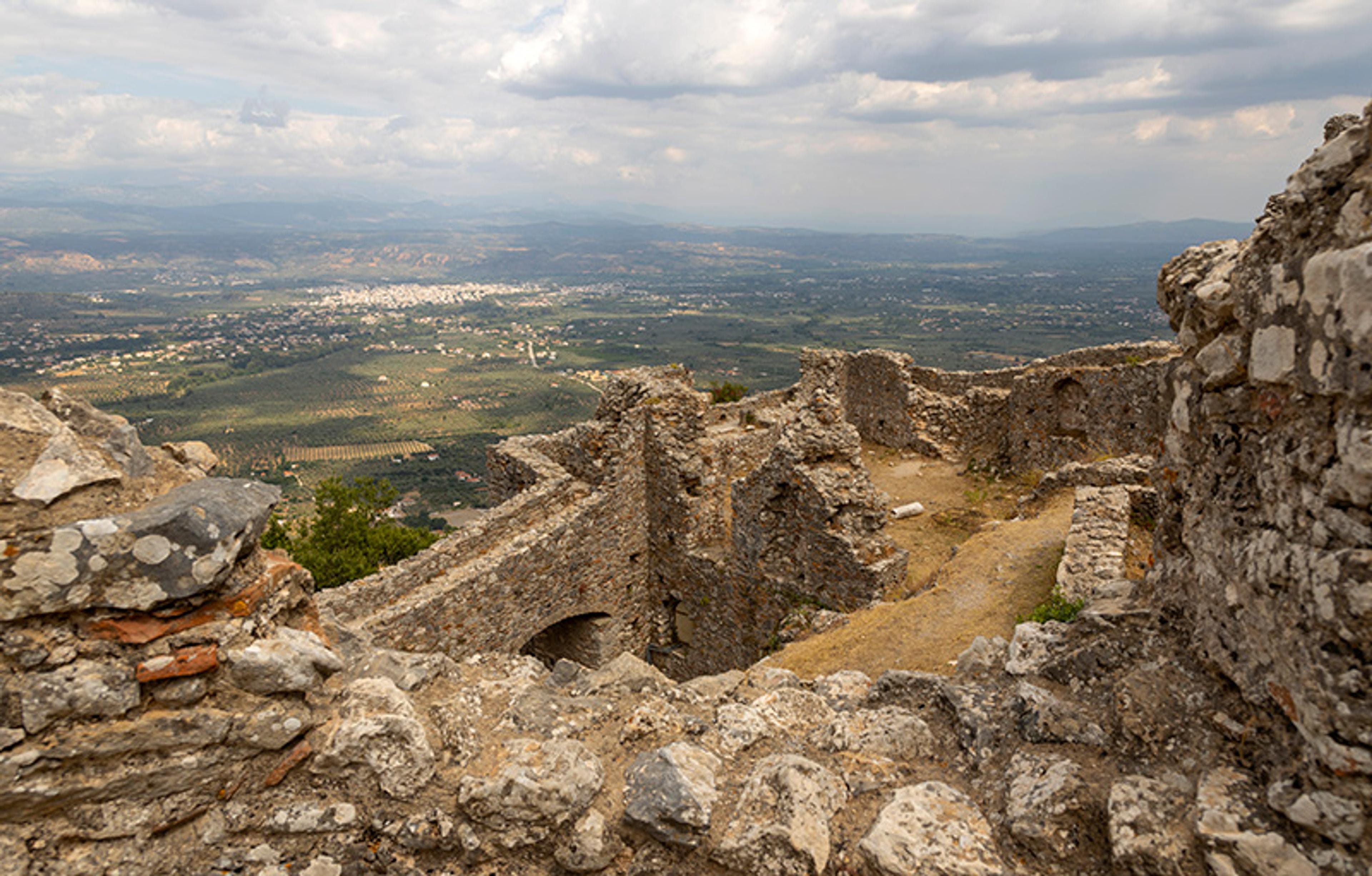
View from the Byzantine ruins of Mystras towards modern Sparta, August 2020. Photo by Athanasios Gioumpasis/Getty
In order to understand this shadowy town, we need to move beyond the idea of a warfare-oriented polis and consider instead her many invisible cities. There is no single Sparta. Indeed, Sparta, like many cities, is akin to the Ship of Theseus, a philosophical paradox posed by Plutarch (46-119 CE). A ship is preserved by the Athenians, who replace the old planks with new planks as they decay. The paradox is whether, by replacing the decaying planks, the ship can still be considered the Ship of Theseus or whether (and when) it becomes something else entirely.
Italo Calvino has a different approach in his novel Invisible Cities. The character of Marco Polo in his text describes 54 cities with female names, which in the end are all one: Venice. At Sparta, where we impose the ideal of one particular history, there is a palimpsest of other cities to be explored. The view from the stoas of the dynasty of the Euryclids, Sparta’s Greek governors during the Roman period, would be very different indeed from the ruin-studded landscape traversed by 18th-century travellers hoping to commune with antiquity, and different again from the grand feasts held at the legendary palace of King Menelaus and beautiful Helen. By peeling back, one by one, these layers of time, Sparta’s story can be scrutinised against our preconceptions, and written anew.
The Sparta that Homer describes is filled with palaces and stockpiles of amber that are the envy of the gods on Mt. Olympus.
Dear friend, do you see how these echoing halls are shining bright with bronze, and silver, gold and ivory and amber? It is as full of riches as the palace of Zeus on Mount Olympus!
It could not be more different from the Sparta that Plato and Plethon and Plutarch seem to have in mind. Either Lycurgus, like Moses, showed up and destroyed everything ancient in Sparta in a fit of iconclastic fervor, or we are talking about two or more very different Spartas. My answer to this riddle is that the tales of Homer are very clearly set in the Baltic, in the lands of the original Prussians.
I was dead set on writing more articles about the war last week, but other than Wildberries, an Amazon-type equivalent in Russia losing its warehouses to strikes, I have had nothing to report. I am also considering peeling off the Primordial Truth section into a separate blog, and giving readers the choice on whether to support the geopolitical stuff or…
It is not just historical trivia, this constant reference and debate of Sparta. This has underwritten all of the performative LARPs of our respective civilisations for centuries now. You do know that Dugin is famous for positing that all of history is just a never-ending battle between Athens and Sparta right?
Ever since Western political thought began to be studied, the ancient city of Sparta has been a constant topic of discussion. It is, like Athens, one of the few political and legal systems to have surpassed the ideals of the authors whose work we have tangible traces and memories of in this field. Plato held it up as a model, while Aristotle and Isocrates both criticized and praised it, at the very time when the famous institutions of Lycurgus were still in place. Rome, whose republican form of government could be compared to that of Sparta, rediscovered these ancient laws through the writings of Polybius and, especially, Plutarch.
References to Greek antiquity are certainly less frequent in the Middle Ages, but Sparta reappears with the Renaissance, particularly in Italy, where the city-state model allows for comparisons—sometimes pertinent, sometimes misleading—with the ancient republics.
Almost as if it was invented in that period.
Lacedaemon became the symbol of the mixed regime. In France, Sparta made its return through Protestant thought, primarily that of the Monarchomachs, who challenged the omnipotence of a Catholic royal power unfavorable to their interests by erecting the image of the Ephors in opposition to it. These magistrates, drawn from the common people, were intended to curb the authority of the kings. From the 16th century onward, Sparta, bolstered by numerous translations of Plutarch, would thus forge its path in our country. Although discreet in the 17th century, it appears in utopian narratives, which extol the virtues of aristocratic models or, more boldly, those of egalitarian societies.
In any case, it always supported the opposition to monarchical absolutism. It was with this reputation that it approached the minds of the Enlightenment. Mably and Rousseau, steeped in Plutarch, took it upon themselves to revive the Spartan “myth” and their shadows hovered over the men of the Revolution who, in order to found a republic, once again adorned themselves with the ancient disguise.
You will find that all of the worst terrorists in history take inspiration from Lycurgus, not Bakunin. And that the worst and most systematic use of terror has always been employed by a tiny minority of hated Elites, outnumbered by huge amounts of non-Elite masses. It is these Isra-Elites who must rely on fear to rule against the masses, and not the other way around. All elite rule is predicated on the use of demonstrative terror to maintain order.
An Isra-Elite is, by definition, a terrorist.
They simply could not maintain the control of such a tiny clique over such a vast population without the use of terror tactics.
But they always accuse us of what they themselves are doing, have you noticed that?
Having said all that, we can talk about the terror wave of the 19th century, Bakunin’s writings and ideas, and who was probably behind it all in another essay.
Yes, I would like to know more about Bakunin. Didn't he tell Marx that your state is going to become too strong and powerful? And Bakunin had many friends and Marx few?
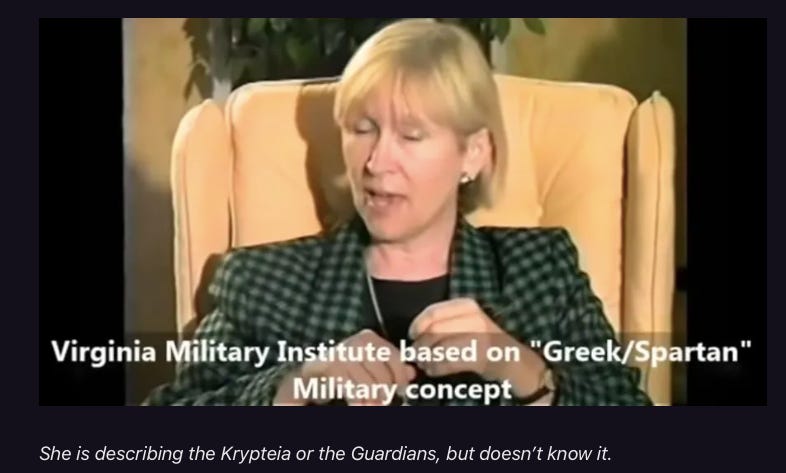
This video, or rather a still from the video, I watched somewhere a long time ago and only now did I understand what they meant by it. But Greek democracy never existed - Athens and Sparta were a 1% elite that ruled over the mob, they were homosexuals, orgies, sex in palaces, gorging, getting drunk - the whole Greek concept is a fraud. A historian in Serbia wrote a book about that Fake Ancient Greece and the influence of faranioti and co. on the Serbian Orthodox Church, who collaborated with the Ottomans to wipe out the Serbian Church. This fucking world is all a lie, the entire conception of the past has been falsified in order to rule over the masses. They destroyed the villages, they destroyed the communities, cities have become modern open-air camps, democracy never actually came to life.






Yes, I would like to know more about Bakunin. Didn't he tell Marx that your state is going to become too strong and powerful? And Bakunin had many friends and Marx few?
This video, or rather a still from the video, I watched somewhere a long time ago and only now did I understand what they meant by it. But Greek democracy never existed - Athens and Sparta were a 1% elite that ruled over the mob, they were homosexuals, orgies, sex in palaces, gorging, getting drunk - the whole Greek concept is a fraud. A historian in Serbia wrote a book about that Fake Ancient Greece and the influence of faranioti and co. on the Serbian Orthodox Church, who collaborated with the Ottomans to wipe out the Serbian Church. This fucking world is all a lie, the entire conception of the past has been falsified in order to rule over the masses. They destroyed the villages, they destroyed the communities, cities have become modern open-air camps, democracy never actually came to life.